Rosemary Cocktails

We made some rosemary syrup for some experiment that we neglected to document. The syrup itself is simple enough to make. Add a few sprigs of fresh rosemary to the pot while making regular simple syrup (1 part sugar to 1 part water) and then strain the rosemary out before jarring. Any sort of herbal syrup, like mint syrup for juleps, would be made the same way and can add a spring to the step of an otherwise ordinary cocktail.

Anyway, it’s been in the fridge for a couple of weeks, and since we don’t know how long it will last, we decided to try and use some of it tonight on a few new experiments. For the first one, we tried a sweet spin on the classic Complement Cocktail, which normally uses akvavit, a Scandinavian liquor that is similar to gin but uses fennel for flavoring instead of juniper. Since you can’t get akvavit in Alabama, we made a a fennel tincture by letting some fennel sit in a jar of vodka for a couple of weeks. We keep the tincture in a dropper  bottle because a little goes a long way.

Rosemary ClooneyThe Rosemary Clooney

  • 2 oz London dry gin
  • 1/2 oz rosemary syrup
  • 1/2 oz St. Germain
  • juice of half a lemon
  • 6 drops of fennel tincture

For our second drink of the night, we chose to use tequila and Armagnac, two ingredients that don’t usually get a lot of love in cocktails. We added a splash of Campari to brighten things up.

The Song of the Forest People

  • 2 oz reposado tequila
  • 1/2 oz rosemary syrup
  • 1/2 oz vsop Armagnac
  • splash of Campari
  • 2 dashes orange bitters

Finally, we decided to try the rosemary syrup with a bourbon cocktail. We happened to have a jar of bourbon infused with mustard seed, which we were inspired to make after having a cocktail with mustard seed apple brandy at Food Bar one night. It seemed like it would go well with the rosemary. The dry sherry and Luxardo helped to round it out.

The Spring Chicken

  • 2 0z mustard seed-infused bourbon
  • 1/2 oz rosemary syrup
  • 1/2 oz dry sherry
  • 1/2 oz Luxardo marischino liqueur

Guest Bartending at Collins Bar

CollinsThis Sunday, January 19, I will be guest bartending at Collins Bar, Birmingham’s newest casual craft cocktail destination. If you haven’t been there, Collins Bar is located on 2nd Avenue North, in the location that used to be Metro Bar. I will be making some of my signature cocktails, plus classics and improvisations.

The Facebook event is here: https://www.facebook.com/events/1442714269280320

Let me know if you plan to drop by, and I’ll try to think ahead of something special for you.

Bartender Profiles: Steva Casey

StevaFew people have done as much to promote cocktail culture in Birmingham as Steva Casey, the bar manager at Veranda on Highlands.

Background

Steva got her start in the restaurant business 17 years ago at Bon Apetit. In 2007, she moved to Little Savannah in Forest Park, where she worked off and on. In 2010, she took over the bar there, and that was when she really started to take off as a bartender. She expanded the horizons of Little Savannah’s bar menu and was frequently quoted in the local press about cocktail recipes.

Cocktail Program

Her cocktail program at Veranda is concentrated on classics and improvs. She says she likes to showcase classics you don’t see everywhere like the Martinez, the Opera, French 75, and Blood and Sand. She also always has a punch on her cocktail list.

In addition, Steva probably makes more Scotch cocktails than anyone else in town (or perhaps anywhere). She says, “With women of a certain age, between 40 and 60, it’s easier to get them to try Scotch than it is to get them to drink gin.”

What’s In Your Well?

Steva uses a lot of quinas, sherries, and other fortified wines in cocktails. “The great thing about Birmingham,” she says, “is that there it already has a great wine culture.” She says that in Birmingham, unlike much of the rest of the South, there are a lot of people with good palates for wine, who appreciate the acids and tannins, and aren’t just looking for a sugar bomb. It’s a short leap from there to sherry, madeira, and port.

Unlike some other prominent bartenders in town, she doesn’t use a lot of Carpano Antica Formula. Her go-to sweet vermouths are Cochi Torino and Punt e Mes.

It’s a Cold, Cold Day

Cold DayCold days remind me of my old music friends Angela and Crystal, late nights strumming guitars and drinking whiskey by the fire. We recorded an album a couple of years ago, including Angela’s song “Cold Day,” which inspired this drink. You can purchase that album here, by the way.

This cocktail is dedicated to Angela and Crystal and to the whole frozen East Coast.

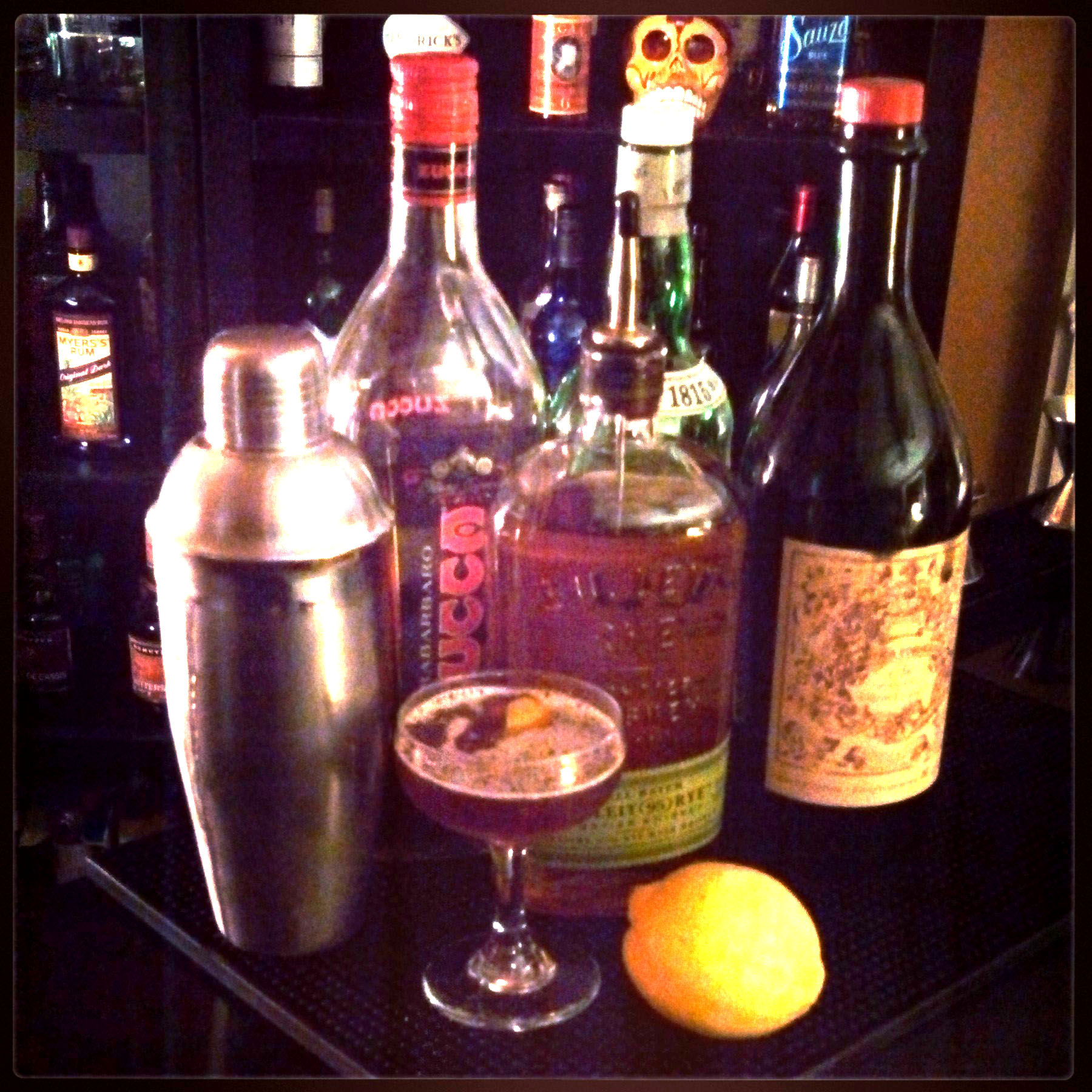
  • 2 oz Bulleit Rye
  • 1/2 oz Carpano Antica Formula
  • 1/2 oz Zucca amaro
  • Laphroaig rinse
  • Lemon twist

Fill a coupe glass with ice and add about a half ounce of the Laphroaig scotch. Add the other ingredients to a mixing glass and stir. Swirl the scotch and ice around in the coupe a few times and then throw the scotch and ice down the drain. Strain the ingredients from the mixing glass into the coupe. Add the lemon twist.

Enjoy while cuddled under an electric blanket with a loved one.

Bartender Profiles: Feizal Valli

In addition to documenting tastings, recipes, and house experiments, we would like to begin profiling some Birmingham bartenders on this site. Our inaugural interview is with Feizal Valli, the bar manager at the recently opened Collins Bar on 2nd Avenue North, where I’ve been invited to do some guest bartending in 2014 (more on that in a later post).

One of the more colorful characters we have met during the course of our cocktail adventures, Valli got his start in the bar business in a strip club on Bourbon Street and then opened his own bar in Capetown, South Africa, before ending up at some of Birmingham’s finest bars and restaurants.

Background

Valli was working a “desk job” in New Orleans when his employers rented out the top floor of a strip club on Bourbon Street during Mardi Gras, and he ended up being the point man for the bar management. A few days later, he happened to run into the owner on the street, and the owner asked him if he knew any bartenders. Even though he had never bartended in his life, he said he was a bartender just for the experience of working at a strip club on Bourbon Street. A weekend of cramming and a generous bar manager helped get him through.

Some of Valli’s experiences in Africa would be better suited to exploration in my other vocation as a novelist, and we’ll leave it at that for now. For various reasons that must remain mysterious, he closed his bar after two and half years and returned to New Orleans, landing a job at Emeril’s NOLA. It was Hurricane Katrina that brought him to Birmingham, seeking refuge from the storm. He started at Highlands then went to Cafe DuPont to 26 to Hot & Hot Fish Club. When Andrew Collins wanted to open a nice cocktail bar downtown, Valli’s name kept coming up in conversation as someone who could run the bar. Valli also designed the interior of the bar, including the kinetic sculpture of paper airplanes hanging from the ceiling and the Birmingham-centric periodic table of elements behind the bar.

CollinsCocktail Program

The concept Valli created for Collins Bar is simple and elegant. There is no cocktail menu. He says, “If you figure out the drinker, you will figure out the drink.” Valli spends time getting to know his customers and designing cocktails customized to specific tastes. In addition, he has some of the heaviest hitters in the Birmingham cocktail scene behind the bar, including Angel Negrin and Josh Schaff.

Another unique angle at Collins Bar is the guest bartending program. Valli says, “Guest bartenders are made up of people who have at least some experience behind a bar but it mostly it’s about how passionate they are about cocktails and how much knowledge they’ve already acquired on their own. Sometimes it’s a nobrainer like Josh Schaff or Steva Casey, people who run their own bars but just want a change of scenery one day a week or it’s someone relatively new like Claire from Octane who’s just a natural at it. In the end it’s someone who in my gut I know cares enough about cocktails and service that I know I can trust them behind my bar. ”

(And did I mention yours truly will be doing a guest slot there this month?)

Creds

Two years ago, Valli won the GQ/Bombay Sapphire Most Inspired Bartender contest in Las Vegas. (This year, it went to another Birmingham bartender, Charley Pinck). Last year, Valli was the only bartender from Alabama invited to Atlanta’s Food and Wine festival, where he ended up in a “Bartender Throwdown.” He was paired with Greg Best from Holeman & Finch Public House for the competition, and they won.

“I’m two for two. No more contests for me,” Valli says. “I’ll quit while I’m ahead.”

What’s in your well?

A bartender’s well contains their go-to bottles. What’s in a bartender’s well says a lot about their personality. Valli has several sweet ingredients in his well, including St. Germain, Domaine de Canton, and Cathead Honeysuckle Vodka. He points out that Angel Negrin’s well is almost the opposite, with bitter liqueurs like Fernet Branca and Cynar. “Angel is like the Lennon to my McCartney,” Valli says.

The Well Bourbon Taste-Off – Part 2

As a result of all the responses we got to our first taste-off of cheap bourbons, we decided we needed to do a second test.

First off, we included all the bourbons from our initial tasting and added two more at the behest of our readers: Old Crow and Benchmark #8. In addition, we invited some friends over so we wouldn’t be relying on our taste buds alone.

Just as before, Jim Beam White Label was our high-end control. We didn’t want anything that cost more than Beam, and the idea was to find something cheaper that was at least as drinkable. If you recall, it was Evan Williams Black Label that won the first round–not surprising since it is the second most expensive (next to Jim Beam) and aged a good bit longer than Beam is. In a preliminary tasting before our guests arrived, we decided both Old Crow and Benchmark were comparable to Evan Williams. But we also wanted to make sure we weren’t full of it, so the real tastings were done blind. Neither we or or guests knew what we were drinking (Jen did the pouring and did not participate), but everyone knew what the possibilities were.

Prices below are based on a 750 ml bottle purchased at a state liquor store in Alabama.

The Contenders:

  • Evan Williams Green Label – aged 3 years, 80 proof, $8.49
  • Old Crow – aged 3 years, 80 proof, $11.99 (for a 1-liter bottle, doesn’t come in a 750 ml).
  • Benchmark #8 – aged 4 years, 80 proof, $9.99
  • Ancient Age – aged 3 years, 80 proof, $11.49
  • Old Grand Dad – aged 4 years, 80 proof, $11.99
  • Virgin Bourbon – aged 7 years, 101 proof, $11.99
  • Evan Williams Black Label – aged 5-7 years, 86 proof, $12.49
  • Jim Beam White Label – aged 4 years, 80 proof, $15.99

The Play by Play: 

Ancient Age. At least two guest tasters found it smooth with hints of caramel to the extent that they guessed it was the more expensive Jim Beam. In their defense, it was a cold, rainy night, and this first impression probably had more to do with warming them from the chill than how the whiskey actually tasted. The remainder of the panel (who had been inside for longer than the other two) pegged it as “cheap tasting” on the front end, though the caramel flavor has a nice linger to it.

Virgin 101. Everyone recognized this was the higher proof option because of the extra bite it carried. “More taste for a shorter time,” said one panelist.

Jim Beam White Label. This made a better showing than in our previous tasting. People honed in one the notes of vanilla.  Someone said it tasted like “Sitting by the fire.” Another called it “Smooth and creamy.” We still think it is overrated though.

Old Crow. One of our friends on Facebook gave this quite a sales pitch, calling it “a straight up friend to a friend in need.” Most of our panel seemed to agree on this and detected spiciness that they liked a lot. One associated it with “summertime.” The outlier on the panel said it was too sweet for them and also had “a fair amount of burn.”

Evan Williams Green Label. One of our panel members detected a “strong lingering in the middle mouth.” Another said, “robust and strong, just like my granddaddy.”

Evan Williams Black Label. This was the bourbon that came out on top in our first tasting. Though a panelist called this “smooth and strong,” it did not stand out as much as it had previously.

Benchmark #8. One of our Facebook friends lobbied hard for this to be included, and we agree that it’s a very good, though quite mild, choice for the price. One panelist said this tasted “familiar” and another characterized it as “weirdly nostalgic.” We were struck by its lack of intensity compared to the others in the tasting.

Old Grandad. We had mixed results on this last one. It could be that tasting fatigue had set in. One panelist tasted a lot of wood. Another said it was bitter and had an aftertaste that made her “face scrunch up.”

After our guests left, we continued some blind tastings on our own to try and come up with some consistent results. Our final decision, after considering all our guest panelists’ comments and our own extensive experiments is that Old Crow is the best for the money. It wasn’t everybody’s favorite, but we have to agree with our friend who said, “Old Crow is not for frolicking, it’s a working bourbon. The bird on the bottle says, ‘If this is the type of stuff you’re going to sign on for, then the enclosed is what you need to drink.'”

The Well Bourbon Taste-Off

We love good bourbons, and we’ve had the best of the best–Pappy Van Winkle, Blanton’s, Woodford Reserve Double-Oaked, etc. We almost always have three or four good bourbons of various stripes–something high proof, something with wheat, something with a higher rye content, plus various rye whiskeys, which is fodder for another post. We also usually keep large quantities of something inexpensive but well made because, you know, we’re not the 1% here.

Poet and cheapskate Phil Theibert, who has visited the Whiskey Thief on occasion, is a big fan and proponent of Old Charter bourbon. It’s aged 8 years, but it’s somehow only about $12 for a 750 ml bottle. There is a long story we could tell you about how the distillery probably pulls this off, but the upshot is that Phil is right. A couple of years ago, we did a tasting of the cheapest straight bourbons we could find at ABC, and we agreed, you could get no better value of bourbon in the state of Alabama at that time. Old Charter has a simple but interesting smoky character. What it lacks in complexity, it makes up for in charm and cheapness. It became our standard for cocktails that call for bourbon where the whiskey probably won’t shine through anyway–whiskey sours, highballs of various sorts, etc.

This week, we were out of Old Charter and went to the store to replenish our stock, but we found that ABC is no longer carrying Old Charter!

So we had to do another tasting, of course. We’d been meaning to do so anyway, since we didn’t document it the first time around. We didn’t want to spend more than about $50, so we got the smallest bottles we could of some of the cheapest brands, including Jim Beam on the higher end of the price range. Due to budget constraints, we did not buy some of the bourbons that would qualify, including Old Crow and Kentucky Gentleman, both of which are the well bourbons at bars we frequent. We might save those for another day.

Contenders had to be “straight bourbon whiskey,” which means (legally), they must:

  • Be made with at least 51% corn in the mash bill
  • Aged at least two years in a new charred barrel made of American white oak
  • Various other minor requirements that are less interesting

Sidebar rant – If you go to the Jack Daniels distillery or their website, they will tell you Jack Daniels is not called bourbon because they use charcoal filtering. That is a line of corporate BS. The only thing that keeps JD from being bourbon is that the company opts out of calling itself bourbon. Since Jim Beam is, and probably always will be, the number 1 selling bourbon in America, Jack Daniels would rather be the number 1 “Tennessee Whiskey” than the number 2 bourbon. Some other bourbons, including three on our list today also use charcoal filtering. The filtering does give the bourbon a sweeter and slightly less intense flavor but does not alter the legal definition of a bourbon.

The prices listed below are for a 750 ml bottle in the state of Alabama.

IMG_20131130_150217_018The Contenders:

  • Evan Williams Green Label – age undisclosed, 80 proof, $8.49
  • Ancient Age – aged 3 years, 80 proof, $11.49
  • Old Grand Dad – aged 4 years, 80 proof, $11.99
  • Virgin Bourbon – aged 7 years, 101 proof, $11.99
  • Evan Williams Black Label – aged 5-7 years, 86 proof, $12.49
  • Jim Beam White Label – aged 4 years, 80 proof, $15.99
  • The one on the end is an airplane bottle of Fighting Cock 103 – aged 6 years, 103 proof, $17.99. Ultimately, we decided this bourbon was in another league than the others, so we didn’t include it in this tasting.

The Play by Play:

Evan Williams Green Label, being the youngest of the bunch (we assume), has a light, uncomplex quality. It seems to have been in the barrel long enough to take on some of the char but not many subtleties of the oak. We are not especially impressed, but we would cook with it.

Ancient Age has more vanilla and caramel, but not very much of either. Tasty enough to use in a pinch if that were all we had.

Old Grand Dad, like EWGL, had the low notes of the char without the the high notes of sweetness that we like in a bourbon. Its advantage over EWGL is that it has a little more intensity from being aged slightly longer.

Virgin is a weird outlier for its price range. We thought the 7-year aging and 101 proof would make it a good contender for the shelf spot left open by Old Charter, but it honestly just didn’t taste very good. Once you get past the high-proof burn, there is some sweetness from the charcoal filtering, but there’s also something sour and off-tasting about it.

Evan Williams Black Label made a much better showing than its younger green brother, whom we must say, was just altogether too green. We got more of the complexity we like, high and low notes, caramel and vanilla from the oak. This could be the one.

Jim Beam, like most things that are wildly popular, just doesn’t live up to its name. Sure, it tastes a little better than Green Label or Old Grand Dad, but not much better. For what you pay, it doesn’t perform. The flavor is simplistic, light and sweet, with no charisma.

Overtime:

We did a few blind tastings in various combinations. Most telling though, was the blind tasting between Jim Beam and Evan Williams (Black Label). We could immediately identify the Beam based on its blandness. Evan Williams wins hands down.

As an academic measure, we also tried the Virgin 101 against Wild Turkey 101. We tried them both in Manhattans to see how they held up against a little vermouth. The Wild Turkey was much spicier, brighter, and more interesting all around. The vermouth didn’t help the weird off-taste of the Virgin.

The Verdict:

We will start keeping some Evan Williams Black Label around for mixing and for making infusions and other experiments. For the money, it’s just the best value you can get around here. You can’t ALWAYS have high-end bourbon, and for those times, you can rest assured that your purchase of Evan Williams will com with the blessings of the Whiskey Thief.
A Few House Cocktails

The first original cocktail we invented, we naturally named after ourselves. It included all our favorite things at the time: rye, cognac, absinthe, bitters, and Domaine de Canton (a ginger liqueur). Originally, we built this drink on the rocks and added sugar, but our tastes have matured (we would like to think). In its current iteration, the Hornbuckle is served Manhattan style, and we let the ginger liqueur take care of the sweetness.

The Hornbuckle

Use a dropper to wash the inside of a coupe glass with Absinthe

In a mixing glass, add:

  • 2 oz rye whiskey
  • .5 oz of brandy or cognac (we recommend E&J XO or Courvoisier VSOP)
  • .5 oz of Domain de Canton
  • 3 good shakes of Angostura bitters

Shake with ice and strain into the coupe. Garnish with citrus peel.


This next one is our take on the Alabama Slammer, which is traditionally a very cloying and unsatisfying concoction of cheap sweet liqueurs and fruit juices mixed with vodka and only sold at crappy bars, usually near the beach. Why is it called an Alabama Slammer? By subbing high proof bourbon for the vodka, using higher quality liqueurs, and being reserved with the proportions, we came up with a version that wouldn’t be out of place at a proper cocktail bar.

The Birmingham Baron

  • 2 oz Wild Turkey 101
  • 1/4 oz Plymouth sloe gin (use no other brand, or make your own; unfortunately, you may have to order it online because it’s hard to find)
  • 1/4 oz DiSaronno amaretto liqueur
  • 1/4 oz Sweet Lucy (the regular, not the cream version)
  • splash of fresh squeezed orange juice or a quality curacao like Cointreau
  • splash of orange bitters

Shake with ice and strain into a coupe glass. Garnish with a luxardo cherry.

A Shrub, not a Shrubbery

The fist time we had a shrub in a cocktail was about two years ago at Little Savannah, here in Birmingham. Then bartender, Steva Casey made us something that included a strawberry/rosemary shrub. Not being familiar with the term, we naturally inquired about it. We’ve seen them a few times since then, but they are only beginning to become popular at nicer cocktail bars in the area. Recently at Bettola, we had a conversation with a bartender there who was starting to experiment with them himself, and as it happened, we had only made our first shrubs a couple of weeks before that.

A shrub is, essentially, fruit and sugar macerated with vinegar. In olden times, shrubs were one of the ways that fruit farmers used up the leavings of their crop at the end of the season. On it’s own, blended with tea, or mixed with club soda, shrubs are potent tonics that fix whatever ails you. They can also add very nice complications to cocktails.

After getting some basics from Amy Stewart and Alice Doyle, we started own own experiments with what we happened to have around. The basic formula is:

  • Take a bunch of fruit and cut it into bite size pieces
  • Use 1/2 cup of sugar (or other sweetener) for every cup of fruit
  • Mix the fruit and sugar. Let it sit in a covered bowl overnight.
  • Transfer to a mason jar
  • Add a bunch of whatever herbs would be good with the fruit
  • Cover with vinegar
  • Shake it up.
  • Let it sit in the fridge for a week, shaking it every day
  • Strain out the solids with cheese cloth into a clean jar

So far our combinations have included cucumber/mint and blackberry/thyme. We used raw apple cider vinegar for both. We have had some excellent shrubs that used balsamic vinegar as well.

The cucumber/mint shrub is lovely in gin cocktails, and the blackberry/thyme goes well with bourbon.

Absinthe

Ah, absinthe. The green fairy. “Hey, isn’t that illegal?” or alternatively, “It’s not real absinthe, right?”

These are rather complex questions.

AbsintheTasting

It has been legal to import absinthe into the United States since 2007, but it was banned for almost 100 years before that. The U.S. was not the only country to ban absinthe. Around 1914, it was pretty much banned everywhere except Eastern Europe and (for some reason) Australia.

How similar it is to the absinthe Poe and Rimbaud drank 150 years ago is up for debate. The controversial element is thujone, a chemical in wormwood oil, which is one of the primary ingredients in absinthe production. Some say it makes you crazy. Others say it makes you hallucinate. Most of these claims are thought to be highly exaggerated, but modern absinthes do have a lower thujone level than the ones in the 19th century did. Our opinion is that the only thing that will make you crazy is the price. You can’t buy any decent absinthe for less than $60, which puts it on par with single malt scotches, pricewise.

Absinthe is a high-proof liquor, but unlike whiskey, it isn’t intended to be consumed straight. The traditional method of serving is to add sugar and ice cold water. Some people like to use a sugar cube soaked in absinthe and set it on fire, which makes for a great show, but it does nothing really for the flavor in the end. Water is added until the absinthe “louches” or changes from translucent to a milky color. One of the major flavor components of absinthe is anise, which doesn’t appeal to everyone. Some have more or less of this flavor and some have a more complex flavor that balances nicely with the anise.

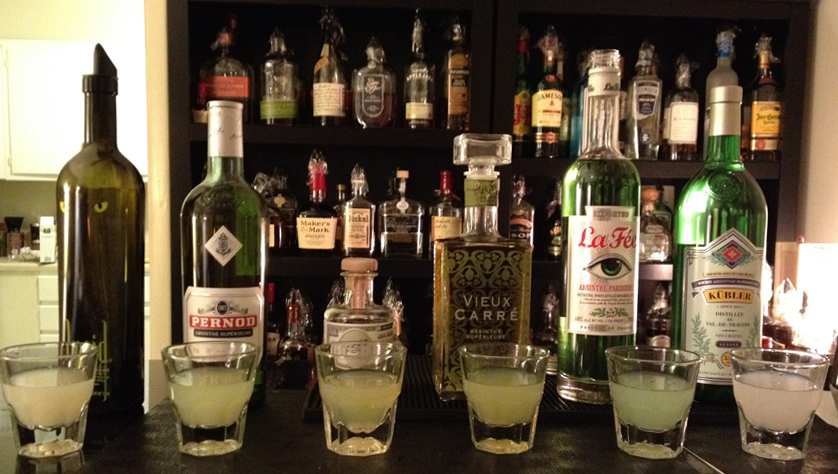
Back during a time when we had a little more spending money than we have now, we did a tasting of six different absinthe brands available in the U.S. They vary greatly in color, proof, and flavor. Here’s a run-down of what we found:

Lucid – Made in France, this was the first absinthe that the U.S. allowed to be imported after the ban. Therefore, it is still the most commonly found. It retails in Alabama for $59.99 and weighs in at 124 proof. It louches to a greenish white color. The flavor is mild and not especially complex. We recommend keeping it in stock for sazeracs and other cocktails that use a small amount of absinthe, mainly because of it’s one of the less expensive brands.

Pernod – Pernod is another French brand and one of the oldest brands around. In fact, they claim to be the inventors of it, although there are others who make the same claim. Pernod remained in the market after the ban by making an anise liqueur that could be used as a substitute for absinthe in cocktails. The absinthe they make now is supposedly identical to the way they made it back in 1805. It louches to a yellowish green. Pernod absinthe is 136 proof and will cost you about $70 a bottle. It’s one of our favorites, but unfortunately, you can’t buy it in Alabama.

La Fee – Also made in France, La Fee is distinguished by it’s neon green color, which turns to a whiter shade of green when louched. It has a strong anise flavor, but is not particularly complex beyond that. It retails for about $60. It’s 136 proof, so a better deal than Lucid at the same price, but alas, you can’t get it in Alabama.

Kübler – Kübler is a Swiss absinthe, which has a little different character than French absinthe. Swiss absinthe is more tends to be more white than green and not as heavy on anise. This absinthe becomes milk white when louched. It’s a relatively light 106 proof and retails for $66 in Alabama (you can get it cheaper elsewhere, though).

St. George – In our opinion, this is the best American absinthe on the market. It has a yellow color and a mild but complex flavor. Its proof is middle of the road at 120. Sadly, you can’t get it in Alabama. If you are travelling to Atlanta or Nashville, you may find it anywhere from $60 to $80.

Vieux Carré – This American absinthe has such a unique, earthy, and grassy character that we have trouble calling it absinthe at all. It doesn’t much appeal to us, but if you don’t like more traditional absinthes, you might give this a try. Like St. George, it’s 120 proof. You can’t get it in Alabama, but you can find it elsewhere for about $60.